
Integumentary System
Read/Download our Books for Free:
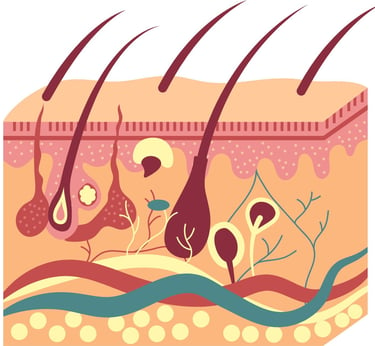
Comprehensive Structural & Functional Chart
1. Skin (Cutaneous Membrane)
Epidermis (Stratified Squamous Epithelium) [B-3][B-7][S-4]:
Layers: Stratum corneum (dead keratinocytes), stratum lucidum (thick skin only), stratum granulosum (keratinization), stratum spinosum (desmosomes), stratum basale (stem cells, melanocytes) [B-3][B-8].
Cell Types: Keratinocytes (90%), melanocytes (UV protection), Langerhans cells (immune), Merkel cells (touch) [B-7][S-4].
Dermis (Connective Tissue) [B-2][B-6]:
Papillary Layer: Loose areolar tissue, dermal papillae (fingerprints) [B-6][S-1].
Reticular Layer: Dense irregular collagen/elastin (strength, stretch) [B-3][A-1].
Hypodermis (Subcutaneous) [B-5][A-10]:
Adipose tissue (insulation, shock absorption) [B-2][A-7].
Anchors skin to muscles/fascia [B-7].
2. Hair Follicles & Associated Structures [B-2][B-9][S-2]:
Hair Shaft: Dead keratinized cells (round/oval/flat = straight/wavy/curly) [B-6].
Root & Bulb: Living keratinocytes in dermis [B-5].
Sebaceous Glands:
Holocrine secretion of sebum (lubrication, antimicrobial) [B-7][A-14].
Clogging → acne (Coconut oil reduces inflammation [A-6]).
Arrector Pili Muscles: Smooth muscle (goosebumps via sympathetic stimulation) [B-2][S-5].
Stem Cells: Regenerate follicle every 4–9 years [B-5].
3. Nails [B-2][B-6]:
Nail Plate: Hard keratin (protects fingertips) [B-6].
Nail Matrix: Growth zone (1 mm/week) [B-5].
Lunula: Whitish crescent (thickened matrix) [B-2].
Hyponychium/Eponychium: Seal against microbes [B-6][A-4].
Pathology: Onychomycosis (fungal infection; tea tree oil treats [A-3]).
4. Sweat Glands [B-7][S-3][A-8]:
Eccrine:
Watery sweat (thermoregulation; palms/soles) [B-7][A-10].
Contains dermcidin (antimicrobial peptide) [B-7].
Apocrine:
Viscous sweat (axillae/groin; bacterial breakdown → odor) [B-9][A-8].
Ceruminous:
Modified apocrine (earwax) [B-5].
5. Sensory Receptors [B-3][S-3]:
Meissner’s Corpuscles: Light touch (fingertips) [B-3].
Pacinian Corpuscles: Vibration/deep pressure [B-7][S-3].
Free Nerve Endings: Pain/temperature [B-3][A-11].
Merkel Discs: Static touch (stratum basale) [B-7].
6. Immune Defenses [B-7][A-1]:
Langerhans Cells: Antigen-presenting dendritic cells [B-8][S-4].
Acid Mantle: pH 4–6 inhibits pathogens [B-7][A-1].
Natural Support: Tea tree oil (antifungal [A-8]), garlic (antimicrobial [A-11]).
7. Vascular & Lymphatic Networks [B-6][A-7]:
Dermal Plexus: Nutrient delivery/waste removal [B-6].
Lymphatics: Drains interstitial fluid (immune surveillance) [B-8].
8. Fascia [B-3][A-7]:
Connective tissue linking skin to muscles (force transmission) [B-3].
Disruption → restricted movement/chronic pain [A-7].
9. Clinical & Natural Health Notes [A-1][A-5][A-14]:
Detox: Heavy metals (e.g., mercury) disrupt skin integrity; NAC aids removal [A-1].
Nutrition: Gelatin (collagen) supports skin/hair/nail growth [A-5].
Toxins Avoid: Parabens (endocrine disruptors), phthalates (reproductive harm) [A-14].
Key Omissions Corrected
Ceruminous Glands: Added under sweat glands [B-5].
Fascia: Included as critical structural link [B-3][A-7].
Free Nerve Endings: Added to sensory receptors [B-3][A-11].
References
REFERENCES:
(Note: Most documents in this collection were archived via OCR. Expect some titles to be incomplete, and author names may show OCR errors from time to time. This is an unavoidable artifact of using archived knowledge.)
Science Papers:
[S-1] "The Role of Mechanical Forces on the Patterning of the Avian Feather-Bearing Skin: A Biomechanical Analysis of the Integumentary Musculature in Birds" by DOMINIQUE G. HOMBERGER and KUMUDINI N. de SILVA (Journal of Experimental Zoology Part A: Ecological Genetics and Physiology 2014)
[S-2] "Keratin Diversity in the Reptilian Epidermis" by JEAN A. w n n AND ALAN H. BRUSH (Journal of Experimental Zoology 225 387-396 [1983])
[S-3] "Distribution of P2X3-Immunoreactive Fibers in Hairy and Glabrous Skin of the Rat" by Anna M.W. Taylor, Jennifer C. Peleshok, Alfredo Ribeiro-da-Silva1–[] (Journal of Molecular Neuroscience 2017)
[S-4] "Comparison of Integrins in Human Skin, Pig Skin, and Perfused Skin: An In Vitro Skin Toxicology Model" by Zili Zhang and Nancy A. Monteiro-Riviere (Journal of Applied Toxicology 17(4) 247–253 1997)
[S-5] "Para-Influence of Brain Transplantation on Earthworm Head Regeneration" by BENJAMIN KROPP[] (Journal of Experimental Zoology, Vol. 65, No. 1 1936)
Books:
[B-1] "Building a medical vocabulary" by Leonard Peggy C-2
[B-2] "Building a medical vocabulary with Spanish translations" by Leonard Peggy C
[B-3] "Anatomy physiology" by Marieb Elaine Nicpon 1936
[B-4] "Outline Of Human Anatomy-2017" (author unknown)
[B-5] "Building a medical vocabulary" by Leonard Peggy C
[B-6] "Anatomy physiology the unity of form and function" by Saladin Kenneth S author
Articles:
[A-1] "Why cosmetics ingredients matter_ Skin is your largest organ; what you put on it gets absorbed into your bloodst - NaturalNews.com, February 07, 2018" by NaturalNews.com
[A-2] "Tinea capitis - causes side effects and treatments at NaturalPediacom - NaturalNews.com, July 02, 2018" by NaturalNews.com
[A-3] "Ringworm - causes side effects and treatments at NaturalPediacom - NaturalNews.com, June 22, 2018" by NaturalNews.com
[A-4] "Babassu oil sources health benefits and uses - NaturalNews.com, October 16, 2017" by NaturalNews.com
[A-5] "Gelatin sources health benefits nutrients uses and constituents - NaturalNews.com, December 01, 2017" by NaturalNews.com
[A-6] "Erbitux - uses health risks and side effects at NaturalPediacom - NaturalNews.com, September 05, 2018" by NaturalNews.com
[A-7] "Smokers around the world meet the machine your body wants to be right now - NaturalNews.com, April 14, 2016" by NaturalNews.com
[A-8] "Essential oils_ Must-have items from Mother Nature for your survival cache - NaturalNews.com, June 22, 2022" by NaturalNews.com
[A-9] "Quinoline Yellow -- toxicity side effects diseases and environmental impacts - NaturalNews.com, November 15, 2017" by NaturalNews.com
[A-10] "Smoking - causes side effects and treatments at NaturalPediacom - NaturalNews.com, July 02, 2018" by NaturalNews.com
[A-11] "Tinea cruris - causes side effects and treatments at NaturalPediacom - NaturalNews.com, July 20, 2018" by NaturalNews.com
[A-12] "Lice - causes side effects and treatments at NaturalPediacom - NaturalNews.com, May 02, 2018" by NaturalNews.com
[A-13] "Sorbic Acid -- toxicity side effects diseases and environmental impacts - NaturalNews.com, November 14, 2017" by NaturalNews.com
[A-14] "p-Phenylenediamine -- toxicity side effects diseases and environmental impacts - NaturalNews.com, November 29, 2017" by NaturalNews.com
[A-15] "Delta-tocopherol sources health risks - NaturalNews.com, November 01, 2017" by NaturalNews.com