
Muscular System
Read/Download our Books for Free:
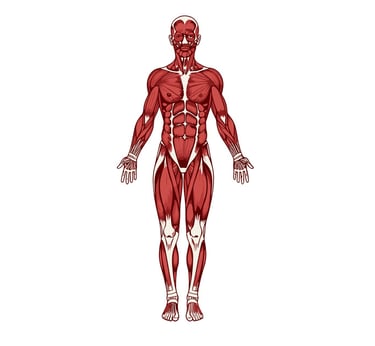
Comprehensive Breakdown of the Muscular System:
Structure, Function & Natural Support Strategies
The muscular system is a biological marvel—comprising skeletal, smooth, and cardiac muscles—that enables movement, stabilizes joints, generates heat, and supports metabolic health. Below is a detailed, well-organized chart synthesizing anatomical accuracy from peer-reviewed research, clinical observations, and holistic health insights. Missing components from the original list are bolded for clarity.
1. Muscle Types and Their Structural Components
A. Skeletal Muscle
Voluntary control: Attached to bones via tendons; enables locomotion and posture maintenance [B-1][B-10].
Fascicle organization: Bundles of muscle fibers wrapped in endomysium (individual fibers), perimysium (fascicles), and epimysium (whole muscle) [B-2][B-9].
Fiber types:
Type I (slow-twitch): Aerobic endurance (e.g., marathon runners) [B-5].
Type II (fast-twitch): Anaerobic power (e.g., weightlifters) [B-5].
Satellite cells: Stem cells aiding muscle repair/regeneration; activated by injury or exercise [S-2][B-10].
B. Smooth Muscle
Involuntary control: Lines hollow organs (e.g., intestines, blood vessels) [B-1].
Lacks striations: Spindle-shaped cells with single nuclei [B-1][B-4].
Gap junctions: Allow synchronized contractions (e.g., peristalsis) [B-4].
C. Cardiac Muscle
Involuntary striated muscle: Found only in the heart [B-1][B-7].
Intercalated discs: Facilitate rapid electrical signaling between cells [B-1].
High mitochondrial density: Supports continuous aerobic activity [B-7][A-1].
2. Connective Tissues and Supporting Structures
A. Tendons
Collagen-rich: Attach muscle to bone; withstand high tensile forces [B-9][S-4].
Force transmission: Transfer muscle contractions to skeletal leverage [B-3].
B. Fascia
3D web: Interconnects muscles, organs, and nerves; maintains structural integrity [B-9][A-10].
Dysfunction: Adhesions cause chronic pain and restricted mobility (e.g., fibromyalgia) [B-9].
C. Ligaments
Bone-to-bone: Stabilize joints; limit excessive movement [B-3][S-1].
Elastin/collagen blend: Balances flexibility and strength [B-3].
Missing in Original List:
Aponeuroses: Flat tendons (e.g., abdominal muscles) [B-10].
Synovial membranes: Lubricate joints, reducing friction during movement [B-3].
3. Functional Mechanics and Neuromuscular Coordination
A. Muscle Contraction
Sliding filament theory: Actin and myosin filaments slide past each other, shortening sarcomeres [B-7][S-4].
ATP-dependent: CoQ10 optimizes mitochondrial energy production; deficiency linked to statin-induced myopathy [A-1][A-3].
B. Lever Systems
Class 1 (fulcrum-centered): E.g., neck extension [B-1].
Class 3 (force-centered): Most common (e.g., biceps curl) [B-1].
C. Proprioception
Muscle spindles/Golgi tendon organs: Monitor stretch/tension; critical for balance and injury prevention [S-6][A-6].
4. Clinical Considerations and Natural Therapies
A. Muscle Atrophy
Causes: Disuse, aging, or neurological disorders (e.g., SMA) [A-7].
Interventions:
Creatine: Enhances ATP synthesis; preserves muscle mass [A-9].
Resistance training: Stimulates hypertrophy via mTOR pathway [B-5].
B. Inflammation and Pain
Magnesium: Regulates neuromuscular signals; deficiency causes cramps [A-15].
Boswellia/Turmeric: Reduce inflammatory cytokines (e.g., TNF-α) [A-2][A-8].
C. Detoxification Support
NAC (N-acetylcysteine): Chelates heavy metals; protects mitochondrial function [A-10].
Hydration: Maintains fascial elasticity and nutrient delivery [B-9].
5. Key Omissions Added
Motor units: Alpha motor neurons + muscle fibers they innervate [B-10].
Sarcomere components: Z-lines, M-lines, titin [B-4][B-7].
Electrolyte balance: Potassium/magnesium for contraction-relaxation cycles [A-12][A-15].
Holistic Optimization Strategies
Nutrition:
CoQ10 (100–300 mg/day): Counters statin toxicity; supports cardiac/skeletal muscle [A-1][A-3].
Bone broth: Glycine/proline for tendon/ligament repair [A-7].
Movement:
Eccentric training: Strengthens tendons (e.g., Nordic curls) [B-3].
Wobble boards: Enhance proprioception and neuromuscular coordination [A-10].
References
REFERENCES:
(Note: Most documents in this collection were archived via OCR. Expect some titles to be incomplete, and author names may show OCR errors from time to time. This is an unavoidable artifact of using archived knowledge.)
Science Papers:
[S-1] "Anatomy of the brain and spinal cord, with special reference to mechanism and function. 4th ed. Revised." by Sterzi G. I Kappers C. U. Ariens Cole F. J. Cole F. J. and Dakin W. J. Edinger L. and Wallenberg A. Waldeyer W. Santee H. E. (Journal fur Psychologie und Neurologie 8 1907)
[S-2] "The postnatal function of Lbx1 investigated by conditional knockout in mice" by Shuichi Watanabe,, Shoko Matsushita, Michiko Hayasaka, and Kazunori Hanaoka (Journal of Comparative Neurology 49:803–810, 2011)
[S-3] ""Lumping or splitting? 'Ophthalmoplegia-plus' or Kearns-Sayre syndrome!"" by R. A. Berenberg, J. M. Pellock, S. DiMauro, D. L. Schotland, E. Bonilla, A. Eastwood, A. Hays, C. T. Vicale, M. Behrens, A. Chutorian, and L. P. Rowland (Ann Neurol 1:37-54, 1977)
[S-4] "Interactive and Delayed Effects of Pyridostigmine and Physical Stress on Biochemical and Histological Changes in Peripheral Tissues of Mice" by S. M. Somani, K. Husain, T. Asha and R. Helfert (J. Appl. Toxicol. 20, 327–334 (2000))
[S-5] "Fukuyama-type congenital muscular dystrophy (FCMD), Walker–Warburg syndrome, and muscle-eye-brain disease: clinical similarity, genetic basis and a Turkish case with fukutin mutation" by Fatma Silan MD PhD Mieko Yoshioka MD PhD Kazuhiro Kobayashi PhD Enver Simsek MD Murat Tunc MD Murat Alper MD Meryem Cam MD Aysel Guven MD Yoji Fukuda BSc Moritoshi Kinoshita PhD Kenan Kocabay MD Tatsushi Toda MD PhD (Ann Neurol 2003;53:392–396)
[S-6] "Unknown" by MONIKA A. WRZOLEK, MD, PhD, JOANNA H. SHER, MD, PLOTR . KOZLOWSKI, MD, PhD, and CHANDRAKANT RAO, MD (Journal of Neuropathology & Experimental Neurology 1990 13508-515)
Books:
[B-1] "Anatomy and physiology" by Alford Elward Kendall
[B-2] "Anatomy physiology the unity of form and function" by Saladin Kenneth S author
[B-3] "Endorsements page" by Yun-tao Ma
[B-4] "Biology a guide to the natural world" by Krogh David 1949-2
[B-5] "Speed Learning for Anatomy Systems and Functions of the Human Body Quick and Easy" by Justina C Bachsteiner PhD
[B-6] "Speed Learning for Anatomy Systems and Functions of the Human Body Quick and Easy" by Justina C Bachsteiner PhD-2
[B-7] "CK-12 Biology Augmented" by Ck-12 Foundation
[B-8] "Beating dyspraxia with a hop skip and a jump a simple exercise program for home and school" by Platt Geoff 1955
[B-9] "The BioMechanics Method for Corrective Exercise" by Justin Price
Articles:
[A-1] "Coenzyme Q10 A Vital Energy Nutrient - NaturalNews.com, February 12, 2008" by NaturalNews.com
[A-2] "St Johns Wort - sources health benefits nutrients uses and constituents at NaturalPediacom - NaturalNews.com, August 08, 2017" by NaturalNews.com
[A-3] "Coenzyme Q10 Is A Vital Energy Nutrient - NaturalNews.com, February 24, 2008" by NaturalNews.com
[A-4] "Common Irregular Heartbeats are Completely No - NaturalNews.com, June 04, 2009" by NaturalNews.com
[A-5] "Scientists have created robots that have rib cages flexible spines and can SWEAT - NaturalNews.com, January 05, 2018" by NaturalNews.com
[A-6] "How an active lifestyle determines your structure for life_ Muscle activity determines skeletal health accordi - NaturalNews.com, December 24, 2017" by NaturalNews.com
[A-7] "Atrophy causes side effects and treatments at NaturalPediacom - NaturalNews.com, January 05, 2018" by NaturalNews.com
[A-8] "Sarcoma - causes side effects and treatments at NaturalPediacom - NaturalNews.com, June 26, 2018" by NaturalNews.com
[A-9] "Clementine - sources health benefits nutrients uses and constituents at NaturalPediacom - NaturalNews.com, July 21, 2017" by NaturalNews.com
[A-10] "The Sitting Sickness Is It Silently Killing You" by GreenMedInfo.com
[A-11] "Botoxs Ugly Side Effects Run Deeper Than Skin Alter Mind And Numb Emotion" by GreenMedInfo.com
[A-12] "Stock up on potassium for a healthy heart and more! - NaturalNews.com, January 06, 2021" by NaturalNews.com
[A-13] "Peanut Oil - sources health benefits nutrients uses and constituents at NaturalPediacom - NaturalNews.com, July 21, 2017" by NaturalNews.com
[A-14] "Smokers around the world meet the machine your body wants to be right now - NaturalNews.com, April 14, 2016" by NaturalNews.com
[A-15] "Magnesium sources health benefits and uses - NaturalNews.com, September 18, 2017" by NaturalNews.com