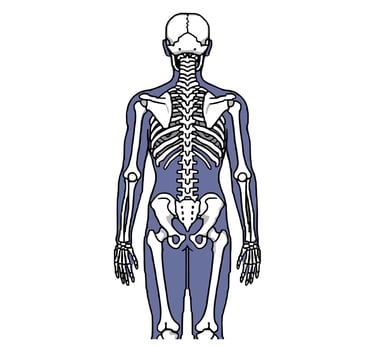
Skeletal System
Comprehensive Analysis of the Skeletal System:
Structure, Function & Natural Support Strategies
The skeletal system serves as the structural foundation of the human body, composed of bones, cartilage, ligaments, tendons, joints, and fascia. Below is a detailed breakdown of its components, supported by interdisciplinary research from anatomy, physiology, and clinical studies, with an emphasis on natural health strategies to maintain skeletal integrity.
1. Bones: The Framework of the Body
Bones are dynamic living tissues that undergo continuous remodeling via osteoblasts (bone-forming cells) and osteoclasts (bone-resorbing cells) [B-5][B-9].
A. Bone Types & Structure
Long bones (e.g., femur, humerus): Act as levers for movement [B-3][B-10].
Short bones (e.g., carpals, tarsals): Provide stability with limited mobility [B-6].
Flat bones (e.g., scapula, sternum): Protect organs and anchor muscles [B-9].
Irregular bones (e.g., vertebrae, pelvis): Unique shapes for specialized functions [B-4].
Sesamoid bones (e.g., patella): Reduce friction and improve leverage [B-6][A-6].
B. Bone Composition
Cortical bone: Dense outer layer resistant to bending [B-9].
Cancellous bone: Spongy inner layer with red marrow (hematopoiesis) and yellow marrow (fat storage) [B-5][S-3].
Periosteum: Fibrous sheath for nutrient delivery and repair [B-9].
C. Bone Growth & Remodeling
Endochondral ossification: Cartilage replaced by bone during development [B-3][S-1].
Epiphyseal plates: Growth zones in long bones until skeletal maturity (~age 25) [B-5][B-9].
Mechanical stress: Weight-bearing exercise stimulates osteoblast activity [B-5][A-9].
Clinical Note: Excessive calcium supplementation (e.g., limestone-based) may weaken bones by disrupting natural remodeling, increasing fracture risk [A-7][A-13].
2. Cartilage: The Shock Absorber
Cartilage is avascular connective tissue critical for joint function [B-9][S-3].
Types of Cartilage
Hyaline cartilage: Covers joint surfaces (e.g., articular cartilage) [B-9].
Fibrocartilage: Resists compression (e.g., intervertebral discs) [B-3].
Elastic cartilage: Maintains shape (e.g., ear, nose) [B-9].
Natural Support:
Boswellia (frankincense): Reduces joint inflammation and cartilage degradation in osteoarthritis [A-1][A-3].
Citrus naringin: Enhances chondrocyte differentiation for cartilage repair [A-3][S-3].
3. Growth Plates: Longitudinal Bone Development
Growth plates (physes) are cartilaginous regions in long bones that enable growth during childhood [B-5][S-1].
Vulnerability: Trauma or malnutrition can disrupt growth, leading to deformities [B-3][A-6].
Hormonal regulation: Growth hormone and sex hormones (estrogen/testosterone) modulate closure timing [B-5][A-9].
4. Ligaments & Tendons: Connective Stability
Ligaments: Bone-to-bone connections (e.g., ACL) [B-9].
Tendons: Muscle-to-bone attachments (e.g., Achilles tendon) [B-10].
Collagen dependency: Vitamin C and silica are critical for synthesis [A-12][B-9].
Injury Recovery:
Bone broth: Rich in collagen, glucosamine, and minerals for connective tissue repair [A-12].
5. Joints: The Articulation Points
Joints are classified by mobility [B-9][B-10]:
Synovial joints (e.g., knee, shoulder): Freely movable with lubricating fluid.
Cartilaginous joints (e.g., pubic symphysis): Slightly movable.
Fibrous joints (e.g., skull sutures): Immovable.
Degenerative Risks:
Osteoarthritis: Linked to chronic inflammation and acidogenic diets [A-11][A-13].
Natural remedies: Turmeric, ginger, and omega-3s reduce joint inflammation [A-8].
6. Fascia: The Overlooked Structural Network
Fascia is a dense connective web integrating muscles, bones, and organs [B-9].
Function: Transmits force, supports circulation, and maintains posture [B-10].
Dysfunction: Chronic dehydration or trauma leads to adhesions and pain [A-12].
7. Skeletal Muscles: The Movers
Muscles attach to bones via tendons, enabling locomotion [B-7][B-10].
Fast-twitch fibers: Explosive power (e.g., sprinting) [B-7].
Slow-twitch fibers: Endurance (e.g., marathon running) [B-7].
Nutrient Support:
Creatine: Enhances muscle energy (ATP) and bone density in aging adults [A-9].
Critical Omissions in the Original List
Medullary cavity: Houses marrow for blood cell production [B-5].
Nutrient foramina: Channels for blood vessel entry [B-3].
Synovial membranes: Line joint capsules [B-9].
Natural Strategies for Skeletal Health
Nutrition:
Vitamin D3 + K2: Directs calcium to bones, not arteries [A-4][A-7].
Plant-based minerals: Silica (horsetail, cucumbers) and magnesium (cacao) support collagen [A-12][A-13].
Avoid processed foods: Acid-forming diets leach bone minerals [A-11].
Exercise:
Weight-bearing activities: Walking, resistance training stimulate osteoblasts [B-5][A-9].
Detoxification:
Heavy metals: Mercury and fluoride disrupt bone metabolism [S-6][A-5].
Herbal Support:
Drynaria fern: Traditional Chinese remedy for bone repair [A-15].
Red clover: Phytoestrogens support postmenopausal bone density [A-2].
Conclusion
The skeletal system is a dynamic, self-renewing structure reliant on holistic support—nutrition, movement, and avoidance of toxic pharmaceuticals (e.g., bisphosphonates) [A-7][A-13]. Prioritizing natural therapies over synthetic interventions ensures long-term resilience against osteoporosis, arthritis, and fractures.
References
REFERENCES:
(Note: Most documents in this collection were archived via OCR. Expect some titles to be incomplete, and author names may show OCR errors from time to time. This is an unavoidable artifact of using archived knowledge.)
Science Papers:
[S-1] "Development of In Vitro Organ Culture Techniques for Differentiation and Growth of Cartilages and Bones From Teleost Fish and Comparisons With In Vivo Skeletal Development" by TSUTOMU MIYAKE AND BRIAN K. HALL (The Journal of Experimental Zoology 268:22-43 (1994))
[S-2] "Sonographic Diagnosis of Lethal Osteogenesis Imperfecta in the Second Trimester: Case Report and Review" by Eberhard Merz and Werner Goldhofer[] (Journal of Ultrasound in Medicine)
[S-3] "Osteochondrogenic Potential of Marrow Mesenchymal Progenitor Cells Exposed to TGF-β1 or PDGF-BB as Assayed In Vivo and In Vitro" by PIERRE CASSIEDE, JAMES E. DENNIS, FELIX MA, AND ARNOLD I. CAPLAN[] (JOURNAL OF BONE AND MINERAL RESEARCH 11 9 1996)
[S-4] "Para-Ellis et al. Study Error and Acidogenic Diets Impact on Bone Health" by H. Erik Meenia, M. I. (JOURNAL OF BONE AND MINERAL RESEARCH 1996 Volume 11 Issue 5)
[S-5] "Cockayne syndrome: unusual neuropathological findings and review of the literature" by Dov Soffer, MD Harold W. Grotsky, MD Isabelle Rapin, MD Kinuko Suzuki, MD (Ann Neurol 6:340-348, 1979)
[S-6] "Chemical Warfare Agents Toxicology and Treatment (Volume 16 of Monographs of Oral Sciences)" by T. C. Marrs R. L. Maynard F. R. Sidell G. M. Whitford S. Karger AG S. Myers H. M. (Journal of Applied Toxicology 17(1) 93-94 (1996))
[S-7] "SOIL AND VEGETATION FLUORIDE EXPOSURE PATHWAYS TO COTTON RATS ON A PETROCHEMICAL-CONTAMINATED LANDFARM" by JACKIE L. SCHRODER, NICHOLAS T. BASTA, DAN P. RAFFERTY, ROBERT L. LOCHMILLER, SOOCHONG KIM, CHARLES W. QUALLS, JR., and KAREN MCBEE (Environmental Toxicology and Chemistry 18 (9) 2028-2033 1999)
Books:
[B-1] "Outline Of Human Anatomy-2017" (author unknown)
[B-2] "John-Prelims" by Nawab
[B-3] "Anatomy and Physiology" (author unknown)
[B-4] "Biology - Inquiry into Life" by Mader
[B-5] "The Indoor Cycling Instructor Handbook" by Angela Reed-Fox-2
[B-6] "The Indoor Cycling Instructor Handbook" by Angela Reed-Fox
Articles:
[A-1] "Protect your bones with 8 natural osteoprotectives - NaturalNews.com, January 31, 2025" by NaturalNews.com
[A-2] "For Successful Healing Cancer Must Be Treate - NaturalNews.com, September 11, 2007" by NaturalNews.com
[A-3] "Specially Fermented Vegetables and Fennel are - NaturalNews.com, November 19, 2012" by NaturalNews.com
[A-4] "Congenital erythropoietic porphyria - causes side effects and treatments at NaturalPediacom - NaturalNews.com, February 21, 2018" by NaturalNews.com
[A-5] "Osteochondroma - causes side effects and treatments at NaturalPediacom - NaturalNews.com, July 10, 2018" by NaturalNews.com
[A-6] "Why Most Doctors are Dead Wrong About Osteoporosis" by GreenMedInfo.com
[A-7] "Mesenchymal chondrosarcoma - causes side effects and treatments at NaturalPediacom - NaturalNews.com, July 10, 2018" by NaturalNews.com
[A-8] "New research reveals creatine benefits for brain bone and healthy aging in women and seniors - NaturalNews.com, October 23, 2025" by NaturalNews.com
[A-9] "Green Tea Extract - sources health benefits nutrients uses and constituents at NaturalPediacom - NaturalNews.com, August 28, 2017" by NaturalNews.com
[A-10] "Mastering the pH Balancing Act Can Improve Yo - NaturalNews.com, March 23, 2008" by NaturalNews.com
[A-11] "The Rebirth of Broth Peasant Superfood and Ultimate Beauty Secret" by GreenMedInfo.com
[A-12] "How Too Much Calcium Can Break Your Bones" by GreenMedInfo.com
[A-13] "Bone cancer - causes side effects and treatments at NaturalPediacom - NaturalNews.com, January 26, 2018" by NaturalNews.com
[A-14] "Drynaria - sources health benefits nutrients uses and constituents at NaturalPediacom - NaturalNews.com, August 28, 2017" by NaturalNews.com